
AP 3302 Pt. 3
Section 1
CHAPTER 3
Factors affecting the performance of Pulse-Modulated Radars
Design Factors Affecting Radar Performance
The main factors in the design of a radar set which affect the performance of the radar are:
a. Transmitter power.
b. Receiver sensitivity and
noise factor.
c. Frequency of operation.
d. Shape of radar beam and
scanning methods used.
e. Pulse repetition frequency.
f. Pulse duration.
Let us now examine each of these factors in more detail.
Transmifter Power
Even with the most concentrated radar beam only a fraction of the energy of each radiated pulse strikes the target. At the target this fraction of the original energy is 'scattered' so that, in turn, only fraction of the incident energy returns towards the receiving aerial. To compensate for this very inefficient reflecting process the greatest possible radiated power must be used. This is why we use peak powers of 1MW and more; but even with such high powers the power in the received echo is only of the order of milliwatts or even microwatts.
 In
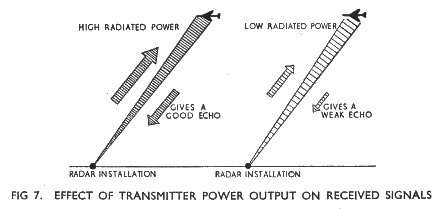
general the higher the radiated power the greater is the received echo power
and hence the greater is the range (Fig 7). However the increase in range obtained
by increasing the radiated power is very small. Even doubling the power increases
the range only 1.19 times.
In
general the higher the radiated power the greater is the received echo power
and hence the greater is the range (Fig 7). However the increase in range obtained
by increasing the radiated power is very small. Even doubling the power increases
the range only 1.19 times.
The power that the transmitter is designed to radiate depends upon the job that the radar has to do. Obviously a long-range search radar needs a very high peak power during the pulses. The power needed by an airfield approach radar, where the required range may be only a few miles, is very much less.
Receiver Sensitivity and Noise Factor
We have already seen that the main limitation on useful amplification in a radar receiver is the relationship between the amplitude of the wanted signal voltage and that of the noise voltage, i.e. the signal-to-noise ratio. If the input has a low signal-to-noise ratio the signal echo on the c.r.t. may be 'lost' among the noise indications. The input signal-to-noise ratio to a receiver is determined by external factors as previously noted and it is, at the moment, the ultimate limitation on the reception of very weak echoes.
In addition, the receiver itself 'generates' noise (valve noise and thermal agitation) and the receiver noise, when combined with the input noise, means that the output signal-to-noise ratio is lower than the input signal-to-noise ratio. The ratio of the signal-to-noise ratio at the input to


