
AP 3302 Pt. 3
Section 1
CHAPTER 3
Factors affecting the performance of Pulse-Modulated Radars
Fig 12 illustrates a beaver-tail beam. This beam, which is narrow in the vertical (elevation) plane and broad in the horizontal (azimuth) plane, is 'nodded' up and down between the scanning limits. It may be used in conjunction with a type B display or a range-height indicator to give quick and fairly accurate determination of the elevation of the target.

Some ground radars use a fan beam and a beaver-tail beam in conjunction to give accurate bearings in azimuth and elevation respectively. This requires two separate aerials, one for each beam shape.
 Some
radars (especially those carried in aircraft) cannot afford the luxury of two
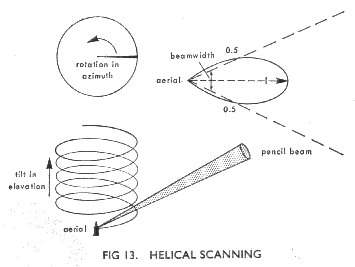
separate aerials. In such cases a single aerial, producing a pencil beam, is
caused to rotate a full 360o in azimuth, a relatively slow upward
tilt being imposed on the aerial at the same time to give coverage in elevation.
This is known as helical scanning (Fig 13). One type of radar aerial using helical
scanning has a beam width of 8o, a tilt of 70o and rotates
at 180 r.p.m.; a complete scan takes about six seconds.
Some
radars (especially those carried in aircraft) cannot afford the luxury of two
separate aerials. In such cases a single aerial, producing a pencil beam, is
caused to rotate a full 360o in azimuth, a relatively slow upward
tilt being imposed on the aerial at the same time to give coverage in elevation.
This is known as helical scanning (Fig 13). One type of radar aerial using helical
scanning has a beam width of 8o, a tilt of 70o and rotates
at 180 r.p.m.; a complete scan takes about six seconds.
Note from Fig 13 that the beam width is the angle between points where the radiated power has fallen to half its maximum value (the 'half-power' or 3db points).
In conical scanning (Fig 14) a pencil beam is used and the axis of the beam rotates to sweep out a circular cone. This type of scan may be used after the approximate bearings in azimuth and elevation have been obtained by other means, e.g. by helical scanning. When the axis of the


