
AP 3302 Pt. 3
Section 1
CHAPTER 4
Some examples of the uses of pulsed radar
The reasons for using the lower frequency have already been mentioned briefly and will be considered in more detail in Sect 3. Again, the pulse duration and p.r.f. can be pre-set relative to each other within the limits, and for the reasons, discussed earlier.
 The
aerial is similar to that discussed for the 10 cm (S band) radar in terms of
dimensions, rotation rate, and tilt angles. But, because of the lower frequency,
both the vertical and horizontal half-power beamwidths for the parabolic reflector
are greater than for the 10 cm aerial. The beamwidths are now 3.3o
vertical and 1.25o horizontal (compared with 1.5o and
0.5o respectively at S band). However, we can use the 'other shape'
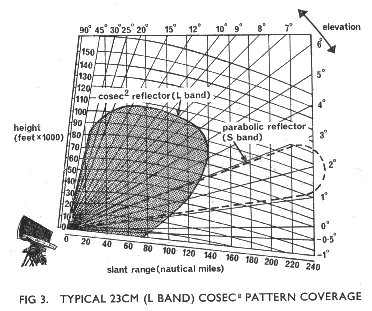
mentioned earlier-namely, shaped to give a cosec2 pattern in the
vertical plane and linear in the horizontal plane; this gives a cosec2
beam-width up to 35o vertically and 1.25o horizontally
at the half-power points, with a reduced aerial gain of 34 db. The vertical
coverage is illustrated in Fig 3.
The
aerial is similar to that discussed for the 10 cm (S band) radar in terms of
dimensions, rotation rate, and tilt angles. But, because of the lower frequency,
both the vertical and horizontal half-power beamwidths for the parabolic reflector
are greater than for the 10 cm aerial. The beamwidths are now 3.3o
vertical and 1.25o horizontal (compared with 1.5o and
0.5o respectively at S band). However, we can use the 'other shape'
mentioned earlier-namely, shaped to give a cosec2 pattern in the
vertical plane and linear in the horizontal plane; this gives a cosec2
beam-width up to 35o vertically and 1.25o horizontally
at the half-power points, with a reduced aerial gain of 34 db. The vertical
coverage is illustrated in Fig 3.
The cosec2 pattern is a modified fan beam with a shape proportional to the square of the cosecant (1/sin) of the elevation angle. It may be obtained by distorting the parabolic shape of the reflector or by feeding the aerial in a different manner (see p 321). The cosec2 aerial has the important property that a target aircraft at a constant height produces a constant amplitude echo for large variations of elevation angle and range to the target. For example, Fig 3 shows that an aircraft flying at a constant height of 70,000 feet produces a constant amplitude of echo as the elevation angle increases from 4o to 35o and as the range reduces from 140 nm.
Combination of S band and L band radars
As stated earlier, many static radar stations have both S band and L band surveillance radars. The arrangement may be as shown in Fig 3, where the 10 cm (S band) radar uses a parabolic reflector to obtain maximum range at low


