
AP 3302 Pt. 3
Section 1
CHAPTER 1
PULSE-MODULATED RADAR
Primary and Secondary Radar
Pulse-modulated radar Systems can be divided into two main groups (Fig 2):

a. Primary radar. This relies on the reflection of a portion of the incident energy by the target. The target does not willingly co-operate with the radar installation. This is the type of radar used to detect and track hostile aircraft and missiles.
b. Secondary radar. In this system the radar installation and the target help each other. The signal received at the radar installation is not a reflection of the incident energy but one from a transmitter, located in the target, which is switched on by the incident energy. An example of secondary radar is the identification equipment carried by all friendly ships and aircraft.
Reflection From Aircraft
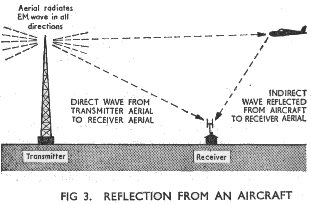 When
watching television you will probably have noticed that when a low-flying aircraft
passes overhead the brightness of the screen increases and decreases causing
the picture to 'flutter'. The reason for this is as follows:
When
watching television you will probably have noticed that when a low-flying aircraft
passes overhead the brightness of the screen increases and decreases causing
the picture to 'flutter'. The reason for this is as follows:
The transmitter aerial radiates an electromagnetic (e.m.) wave in all directions. The receiver aerial normally picks up only that part of the wave which travels in a direct line between the aerials. However, if part of the transmitter wave encounters an aircraft it is re-radiated or reflected from the air-craft and may cause another input to the receiver aerial (Fig 3). The total input to the receiver is the combination of the direct and reflected signals and


