
AP 3302 Pt. 3
Section 1
CHAPTER 2
Basic Requirements Of A Pulse-Modulated Radar System
A radar transmitter also operates at a very high frequency and, for the duration of each pulse, produces a very high peak power output. Frequencies up to 30,000 Mc/s are common and peak powers of 1MW and more are used. The high powers are necessary to ensure adequate 'illumination' of the target so that a good echo may be received. We shall see the reason for the use of the high frequencies later.
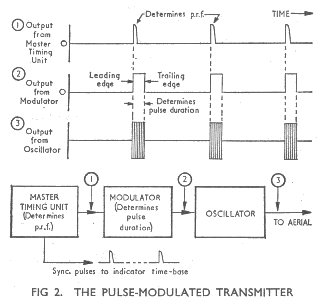
The system used to produce the high-frequency, high-power pulses of short duration at a required repetition rate is illustrated in block schematic form in Fig 2.
 a.
Master timing unit. This unit produces timing pulses which recur at precise
and regular intervals of time and so determines the p.r.f. of the equipment.
The indicator time-base is synchronized with the transmitter pulses by applying
'sync pulses' from the master timing unit to the indicator timebase. This causes
the trace to move across the screen of the c.r.t. at the instant the transmitter
fires each pulse.
a.
Master timing unit. This unit produces timing pulses which recur at precise
and regular intervals of time and so determines the p.r.f. of the equipment.
The indicator time-base is synchronized with the transmitter pulses by applying
'sync pulses' from the master timing unit to the indicator timebase. This causes
the trace to move across the screen of the c.r.t. at the instant the transmitter
fires each pulse.
b. Modulator. Because of the high rate of switching (many hundreds of pulses per second) and the very short time intervals being used (a few microseconds at the most for the pulse duration) the transmitter operation cannot be controlled by normal switches or relays. The circuit which does this switching, and also supplies the input power required by the oscillator, is the modulator. It is an electronic circuit which is 'triggered' by the output from the master timing unit and which produces a d.c. pulse whose duration is determined by the circuitry of the modulator. This d.c. pulse of controlled pulse duration, recurring at the precise instants of time determined by the master timing unit, is used to switch the oscillator on and off.
c. Oscillator. This unit generates the high-frequency oscillations at the high power required. It is switched on by the rising or leading edge of the d.c. pulse from the modulator and is switched off by the falling or trailing edge of the pulse. Thus the transmitter produces a pulse of r.f. energy at the frequency of the oscillator. We shall see later that to produce the very high frequencies at the high powers needed by centimetric radars the oscillator uses special microwave devices (e.g. magnetrons or klystrons). Note also that although the pulse duration may be very short the frequency is sufficiently high to ensure that each pulse contains a large number of cycles of radio frequency (fig 3). For a frequency of 3,000 Mc/s and a pulse duration of 1 us each pulse contains 3,000 cycles.


