AP 3302 Pt. 3
Section 2
CHAPTER 2
Square Waves applied to CR circuits
Subsequently C discharges through R causing Vc to fall exponentially from + 60V towards zero and Vr to rise exponentially from -60V towards zero (Fig 3).
As we can see from Fig 3 the period of the square wave applied to the CR circuit is such that C can just charge or discharge completely during each half-cycle. We can also see that the waveforms of voltage across C and across R are not square waves.
Variations in the Basic Circuit
If a sudden voltage (a voltage 'step') is applied to a CR circuit in which C already has an initial voltage, the time constant is still CR seconds to the voltage step. In time CR seconds the voltage across C changes by 63 per cent of the difference between its initial voltage and the voltage step. Thus if C is charged initially to 20V, and 100V is then suddenly applied to the circuit,
Vc rises to 20 + (63/100 x 80) = 70.5V in CR seconds and to 100V in 5 CR seconds (Fig 4).
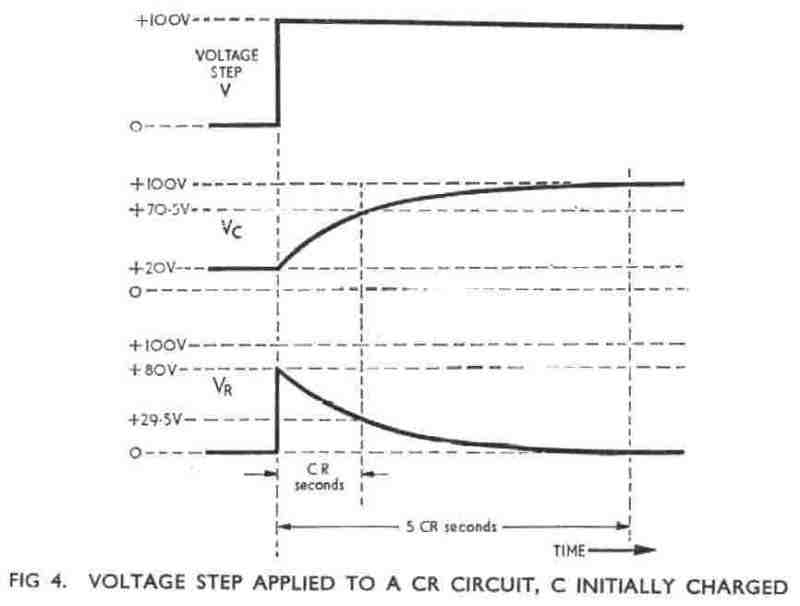
As before, V = Vc + Vr. Hence at the instant the voltage step V is applied, Vr = 80V. It then falls to zero as Vc rises to 100V.
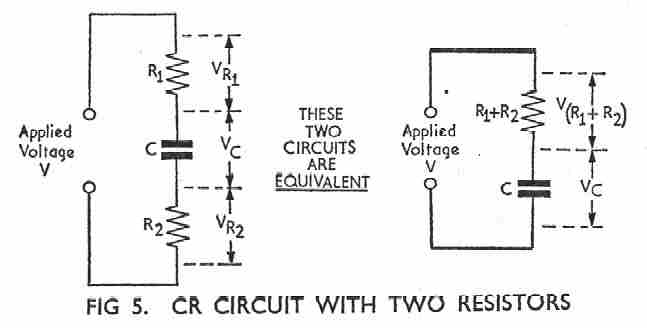
A circuit with two or more resistors connected in series with a capacitor behaves as if the resistors were replaced by a single resistor equal in value to their sum (Fig 5).
The formula V = Vc + Vr now becomes:-
V=Vc+Vr1+Vr2