AP 3302 Pt. 3
Section 2
CHAPTER 7
Monostable and Bistable Multivibrators
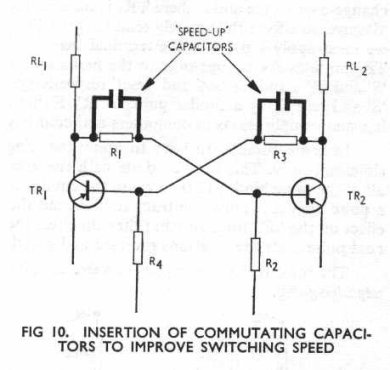
So far we have assumed that the output electrode has no capacitance connected to it so that the voltage at the output electrode can rise and fall very rapidly, giving steep-sided outputs. In practice, the grid-cathode input capacitance (in the valve version) and the base-emitter input capacitance (in the transistor version) will charge and discharge via the appropriate cross-coupling resistance in accordance with the voltages acting on the capacitances. This charge and discharge obviously takes time and the result is that the switching speed is limited and the output wave-forms are not so steep-sided. To reduce theseo effects, Eccles-Jordan circuits often have small capacitors in parallel with the cross-coupling resistors (Fig 10). These 'speed-up' or 'commutating' capacitors cause faster switching because any voltage change at the anode (or collector) is immediately transferred to the input of the opposite stage.