
 "
What did you do in the "Cold War" Dad?"
"
What did you do in the "Cold War" Dad?"
Part
1 - Royal Air Force Apprentice
(Apprentices
"wheel", RAF Locking crest & No.1 Radio School crest purloined from RAF Apprentices
and Boy Entrants home page: http://www.appbe.com/)
|
"Train up a child in the
way he should go; and when he is old he will not depart from it" |
I always had a fascination of the R.A.F. as a child, most likely because of my Dad's R.A.F. Service. As a kid in Sheffield in the late 1950's I wore an old R.A.F. battle dress jacket that sported sergeant's stripes as I flew my Spitfire through the skies in the remorseless search for "Jerry" (in reality my Spitfire was an old deep sea crate in the back garden, panted black and with a blue stripe painted diagonally across the sides. Round tobacco tin lids were my instruments and a bit of broom handle was the "stick"). Dad served his apprenticeship at R.A.F. Cranwell around 1947 and went on to work on radar and radio systems world wide. My education suffered terribly as a result (Dave Turner finally taught me how to do mathematical fractions when we worked together at Krupp Atlas-Elektronik in 1980 and my spelling only improved when PC spelling checkers came along to show me the errors of my ways!) but how many kids get to go to Germany, Hong Kong, Singapore, Zambia as well as the length and breadth of England and Wales as a result of their father's career?
I started getting interested in radar when Dad was posted to R.A.F. Boulmer, Northumberland, in 1967. It was the first time I'd been close to any radar and the huge Type 85 radar was right next to a passing road, within easy reach of a lad on his bike. I started getting books about radar from the public library in Alnwick and I caught the radar bug. I was finally hooked for life when I got to tour the enormous Type 85 radar with my Dad during a families day. As I stood in the control room looking at the screens and that giant mimic display I knew in my heart what I wanted to do when I left school.
Dad got the forms for me and helped me fill them out. Eventually I was instructed to report to the R.A.F. Careers Information Office in Newcastle upon Tyne for "Selection" . There were dozens of other boys there too, we sat at desks for most of the day completing tests of all kinds that I assume were to designed to find our capabilities. Then we were sent to an Army barracks for a medical - just me and one other boy whom I never saw again. There were some interviews too, an officer asked me why I wanted to be a radar fitter, I gave a lame answer to the effect that there would always be a need for them - I was nervous and inarticulate and I couldn't bring myself to tell him that I wanted to do this to the exclusion of everything else. Then came weeks of nerve wracking impatience, waiting to hear if I'd been successful - or not.
 I joined the Royal Air Force on the 27th of October 1970 as an apprentice, or "Brat", and trained as a ground radar fitter (LFit GR) at the No.1 Radio School, RAF Locking near Weston-Super-Mare in Avon, England (aka Weston-Super-Mud;
if you've been there you'll know what I mean!). For the first few weeks our uniform comprised of grey overalls, blue shirt (with detachable collar and collar studs!), underwear, black socks, DMS boots and a beret. Once some of the wheat had been sorted from the chaff we were issued with regular uniforms. Apprentices could be identified by the coloured hat band on their No.1 uniform peaked cap (green for Locking), a coloured disk behind the RAF hat badge (denoting the "flight" the apprentice was
in - blue for G flight when I was there) and the propeller badge
I joined the Royal Air Force on the 27th of October 1970 as an apprentice, or "Brat", and trained as a ground radar fitter (LFit GR) at the No.1 Radio School, RAF Locking near Weston-Super-Mare in Avon, England (aka Weston-Super-Mud;
if you've been there you'll know what I mean!). For the first few weeks our uniform comprised of grey overalls, blue shirt (with detachable collar and collar studs!), underwear, black socks, DMS boots and a beret. Once some of the wheat had been sorted from the chaff we were issued with regular uniforms. Apprentices could be identified by the coloured hat band on their No.1 uniform peaked cap (green for Locking), a coloured disk behind the RAF hat badge (denoting the "flight" the apprentice was
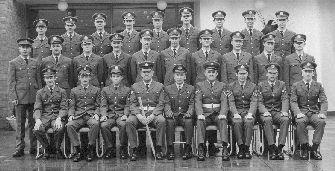
in - blue for G flight when I was there) and the propeller badge 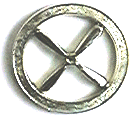 or "wheel" worn above the left elbow on the uniform jacket sleeves. Yours truly is fourth from the left, centre row in this picture of the R.A.F.'s finest; G flight, 219 Entry (Radar) Craft
Apprentices. If you look very carefully you might be able to make out my moustache; I had to get permission to grow that! Check out the shine on those boots too, it could take hours of spit and polish to get a shine like that then someone would ruin your day by standing on your toes! Click on the picture for a larger view with names.
or "wheel" worn above the left elbow on the uniform jacket sleeves. Yours truly is fourth from the left, centre row in this picture of the R.A.F.'s finest; G flight, 219 Entry (Radar) Craft
Apprentices. If you look very carefully you might be able to make out my moustache; I had to get permission to grow that! Check out the shine on those boots too, it could take hours of spit and polish to get a shine like that then someone would ruin your day by standing on your toes! Click on the picture for a larger view with names.
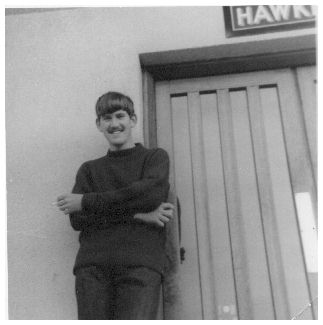 The first couple of months of the two year apprenticeship were taken up with "Bull" (cleaning and polishing everything!), parade drill and marching everywhere. Bull sessions were hard work. The Leading Apprentice would lay great dollops of
orange polish from a large tin on to the blue linoleum floor of the billet with a broom handle. We then got onto our hands and knees and polished the floor by hand with pieces of material torn from our bed blankets. Finally the floor was buffed up to a mirror finish using a "bumper" (a lump of cast iron with a hinged broom handle that rested on a pad of blanket material) that was swung vigorously back and forth across the floor. After a few weeks you found yourself sleeping under scraps of blanket
the size of a small bath towel and feeling very cold at night; fortunately we were issued with new blankets just before terminal hypothermia set in. We next took a length of cord and stretched it down the length of the billet using the door posts at each end as a guide. We then carefully manoeuvred all the beds out from the wall (without marking the floor!) until the ends were just touching the cord, thus forming a perfect line of ten beds, a sight bound to please the eye of the most critical drill sergeant -
we hoped. We then repeated the procedure for the other side of the room. Bed packs, where the sheets, blankets and pillows are formed up into a square and wrapped around with a blanket, were the bane of my life. The blessed things had to have perfectly square corners, a fraction out and you could be treated to the site of your bed pack being thrown out of the window, into the rain as often as not. We soon learned to make up cardboard formers that helped to produce the desired result. I recall sleeping on the
bed springs one night; having formed the perfect bed pack I was not about to give it up!
The first couple of months of the two year apprenticeship were taken up with "Bull" (cleaning and polishing everything!), parade drill and marching everywhere. Bull sessions were hard work. The Leading Apprentice would lay great dollops of
orange polish from a large tin on to the blue linoleum floor of the billet with a broom handle. We then got onto our hands and knees and polished the floor by hand with pieces of material torn from our bed blankets. Finally the floor was buffed up to a mirror finish using a "bumper" (a lump of cast iron with a hinged broom handle that rested on a pad of blanket material) that was swung vigorously back and forth across the floor. After a few weeks you found yourself sleeping under scraps of blanket
the size of a small bath towel and feeling very cold at night; fortunately we were issued with new blankets just before terminal hypothermia set in. We next took a length of cord and stretched it down the length of the billet using the door posts at each end as a guide. We then carefully manoeuvred all the beds out from the wall (without marking the floor!) until the ends were just touching the cord, thus forming a perfect line of ten beds, a sight bound to please the eye of the most critical drill sergeant -
we hoped. We then repeated the procedure for the other side of the room. Bed packs, where the sheets, blankets and pillows are formed up into a square and wrapped around with a blanket, were the bane of my life. The blessed things had to have perfectly square corners, a fraction out and you could be treated to the site of your bed pack being thrown out of the window, into the rain as often as not. We soon learned to make up cardboard formers that helped to produce the desired result. I recall sleeping on the
bed springs one night; having formed the perfect bed pack I was not about to give it up!
Uniforms had to be bulled too; shoes and boots bulled to a mirror finish using spit and polish, brass buttons polished to a high shine using a device known as a "button stick " (a rectangular piece of brass sheet with a slot cut in it), the bac k of the button was fed through the slot and the button was polished without getting "Brasso" on the material; repeated polishing soon ens ured that the devices pressed into the brass, eagles and so on, were soon worn away to mere bumps whilst small scratches and pits disappeared entirely. Uniforms were ironed, the creases perfect and seams straight. One evening the Station Adjutant, an attractive WRAF officer as I recall, came in to show us how to press our shirts properly. We would be inspected every morning; woe betied any boy who was sloppy in his appearance!
The hectic pace of the first few weeks of apprentice training left little time for out of hours socialising. The Flowerdown club, named after an early training school, contained the apprentices NAAFI, public telephones and several televi sion rooms. Dances, known as "discos" or "musical piss ups" were held weekly. Underage boys (the majority) had a large tabled area and a counter at which they could purchase sticky buns and soft drinks. The older boys had a small bar where alcohol could be consumed. One had to be careful though, for as often as not the Flight Sergeant Apprentice would be holding court with his entourage and the newly come of age could easily fall for their tricks! It was a right of passage to enter that bar and one felt so grown up standing there sipping a pint of beer. I was always amazed at how quickly the bar emptied when the "Tom & Jerry" cartoon music filtered through from a nearby TV room; I soon learned that this was common throughout the R.A.F.!


